Reward
What actually gets rewarded?
 BRAKE YOUR LIMITDecision SystemsReveal your Decision Tax
A field of practice developed within Decision Lab
Decision Ecology is a way of examining the environments that make certain judgments, behaviors and outcomes more likely than others.
Decision Ecology studies the relationship between judgment and the environments that shape it.
A decision environment is the local set of conditions around judgment: incentives, norms, power, information, trust, history, technology, attention, constraints and time.
A decision ecology is the network of those environments interacting across the individual, relationship, team, organization, industry and societal levels.
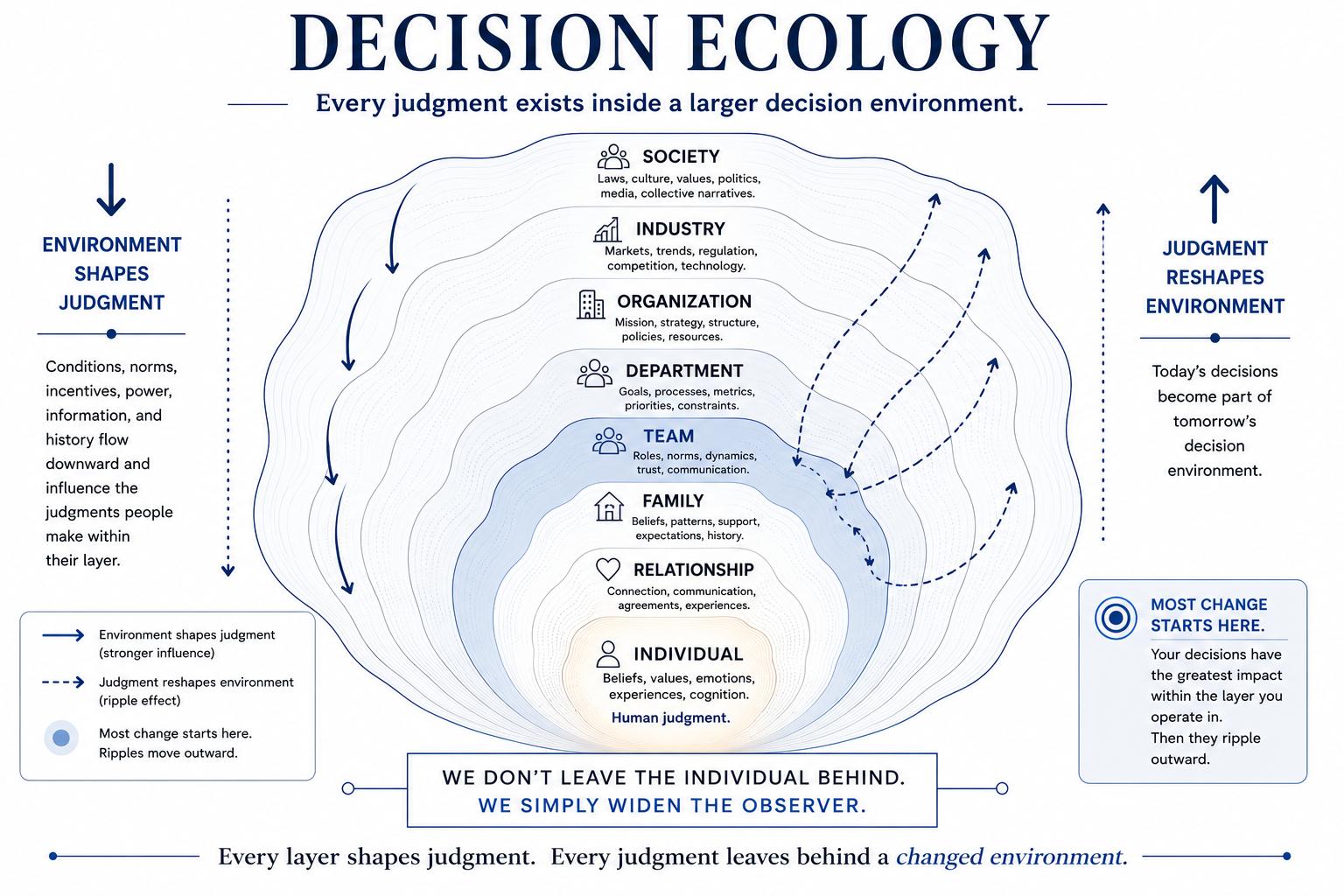
The ten environmental lenses
What actually gets rewarded?
What becomes costly or discouraged?
What reaches decision-makers—and what is missing?
Who can influence the decision and its outcome?
What has become unsafe to say?
What future problems are being borrowed?
What keeps getting stronger through repetition?
What has become normal and invisible?
What have people learned to do inside these conditions?
Which small environmental change could create the greatest downstream effect?
The decision being judged may not be the source. It may be the product.
Decision Ecology does not remove individual responsibility. It prevents repeated problems from being reduced to individual failure when an environment keeps producing the same pattern with different people.
The practical aim is to find the highest-leverage condition, test a bounded intervention and observe whether the decision environment actually changes.