
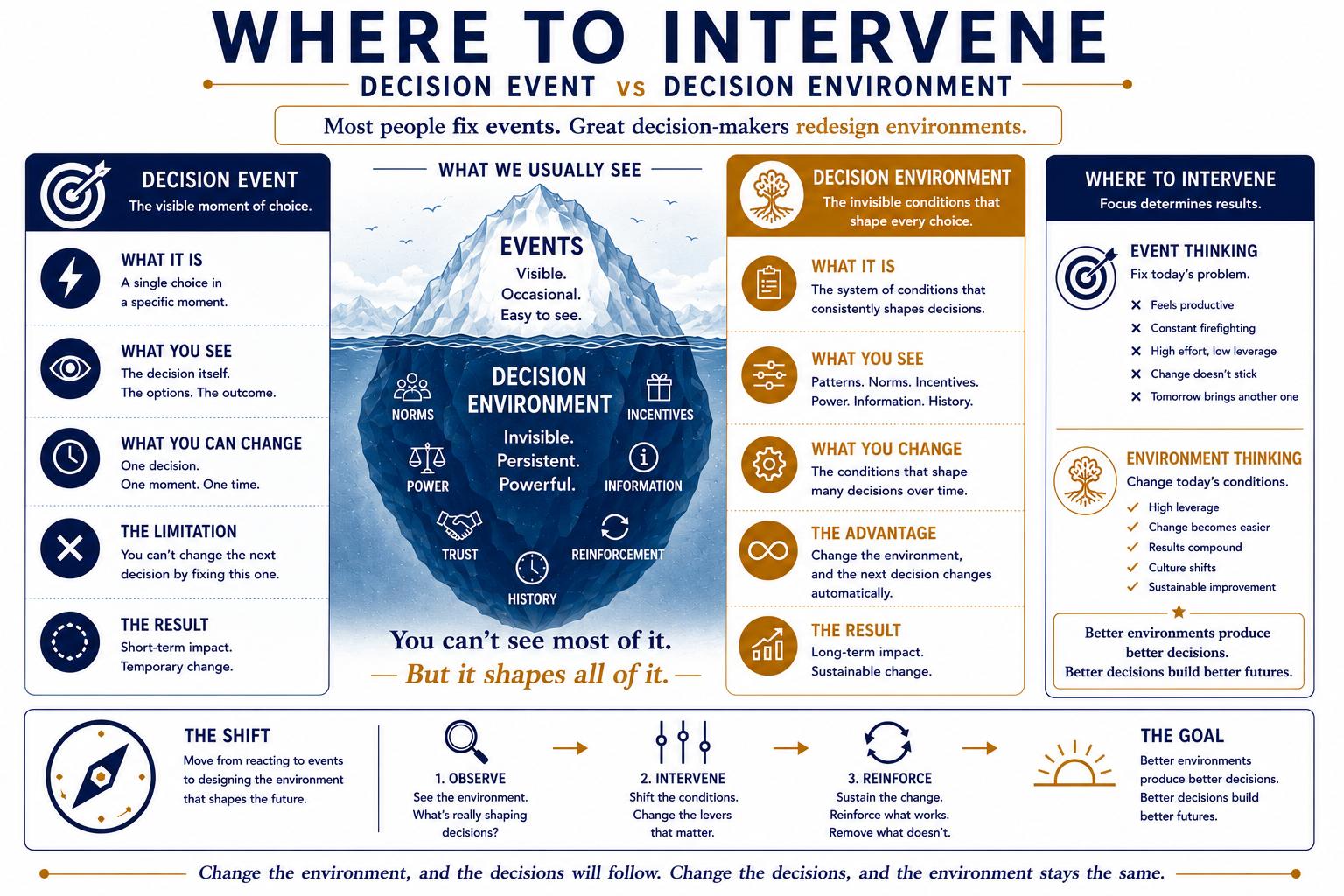
A missed target, a poor hire, a delayed conversation, a failed initiative, or an exhausted leader appears as an event. Events are easy to point at because they have a moment, an owner, and an outcome. The environment that made the event likely is quieter.
Events invite explanation. Environments require observation.
When something goes wrong, the first questions are: Who decided? What did they know? Why did they choose that? Those questions matter, but they begin after much of the decision has already been shaped.
A decision environment includes the incentives, norms, information, power, trust, history, constraints, technology, attention, and time surrounding judgment. It influences what becomes visible, what feels safe to say, which option appears realistic, and what kind of delay seems acceptable.
Do not ask only, “Who caused this?” Ask, “What produced this?”
The same environment can produce different people making similar decisions.
If hiring norms reward speed over fit, replacing one hiring manager may not change the next hire. If silence is safer than disagreement, a new meeting format will not make critical information travel. If every short-term rescue earns recognition, firefighting will keep defeating prevention.
This does not remove individual responsibility. It prevents responsibility from becoming an excuse to leave the production system untouched.
Look beneath the event
- Name the visible event without interpreting it.
- Identify the repeated behaviors surrounding it.
- Ask what is rewarded, punished, hidden, or unsafe.
- Find the condition with the greatest downstream leverage.
- Change one bounded condition and define what evidence would show a response.
Today’s decisions become tomorrow’s conditions.
A decision does not end when the choice is made. It teaches the environment what to keep. A rushed exception can become a new norm. A leader who reclaims delegated authority can reinforce dependence. A difficult truth that is welcomed can increase the probability that the next truth travels sooner.
This is the central loop in Decision Ecology: conditions shape judgment, judgment shapes decisions, and decisions continually recreate conditions.
Where should you intervene?
Event-level action is necessary when something immediate must be contained. Environmental action becomes essential when the pattern is repeated, travels across different people, or returns after apparently sensible fixes.
Make the environment observable enough to catch and change the pattern before it produces another event.
About the author
Ian Brake, MBA
Ian is the founder of Brake Your Limit and creator of Decision Lab. His work brings operating experience and decision systems together to help people and organizations see what is shaping judgment before a poor decision costs time, trust, or opportunity.
See earlier.
Decide better.
Bring a real decision into Decision Lab and practice while you can still change what happens next.
See how Decision Lab works