
Free framework · Decision Ecology
Decision Environment Audit
A structured way to examine the environment producing a decision before treating the visible decision as the whole problem.
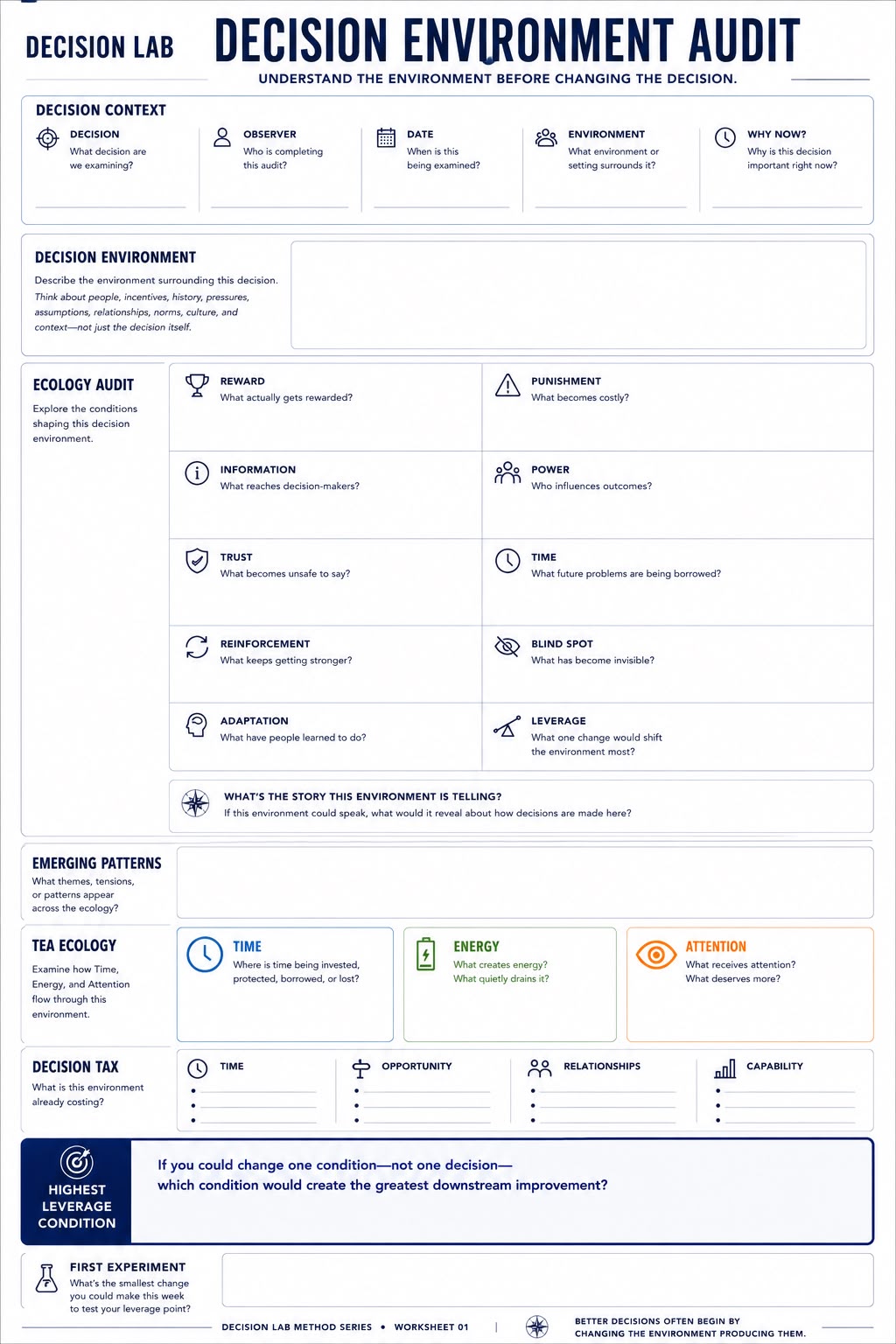
A Decision Environment Audit examines the conditions surrounding judgment—what is rewarded, punished, communicated, controlled, trusted, borrowed from the future, reinforced, normalized, adapted to, and available for change.
When this framework helps.
- The same problem returns after several sensible fixes.
- Different people produce similar outcomes inside the same team or system.
- A decision appears irrational until its incentives and risks are examined.
- You need to find one condition that could create meaningful downstream change.
How to use it.
Name the decision
Describe the choice or recurring outcome without diagnosing who caused it.
Describe the environment
Record the people, pressures, incentives, history, norms, constraints, relationships, and information surrounding it.
Scan the ten lenses
Examine reward, punishment, information, power, trust, time, reinforcement, blind spots, adaptation, and leverage.
Find the pattern
Look for conditions that connect several observations rather than selecting the most dramatic symptom.
Choose one leverage point
Identify the smallest environmental change likely to alter future judgments.
Run an experiment
Define a bounded action and the observable evidence that would show the environment is changing.
Worked example
A team keeps missing project deadlines.
An event-level response might add another reminder or blame the project owner. The audit could reveal that estimates are rewarded for optimism, bad news becomes costly to share, decision-makers receive status reports too late, and teams borrow time from future work. The highest-leverage intervention may be changing when uncertainty is surfaced and what planning behavior is rewarded—not adding another deadline.
Common mistakes.
- Using the audit to remove individual responsibility.
- Scoring quickly without recording concrete observations.
- Treating every weak condition as equally important.
- Choosing a solution before identifying the pattern.
- Calling a belief an observation without evidence.
Questions people ask.
Is a decision environment the same as company culture?
Culture can be part of a decision environment, but the environment is more local and specific. It also includes incentives, information, power, trust, time, relationships, constraints, and history around a particular judgment.
Can individuals use the audit?
Yes. A decision environment can exist around a personal, relational, family, team, organizational, or societal decision.
Does the audit produce a score?
It can support ratings, but its primary purpose is visibility. A number matters less than the observations and leverage condition it helps reveal.