
Free framework · Upstream intervention
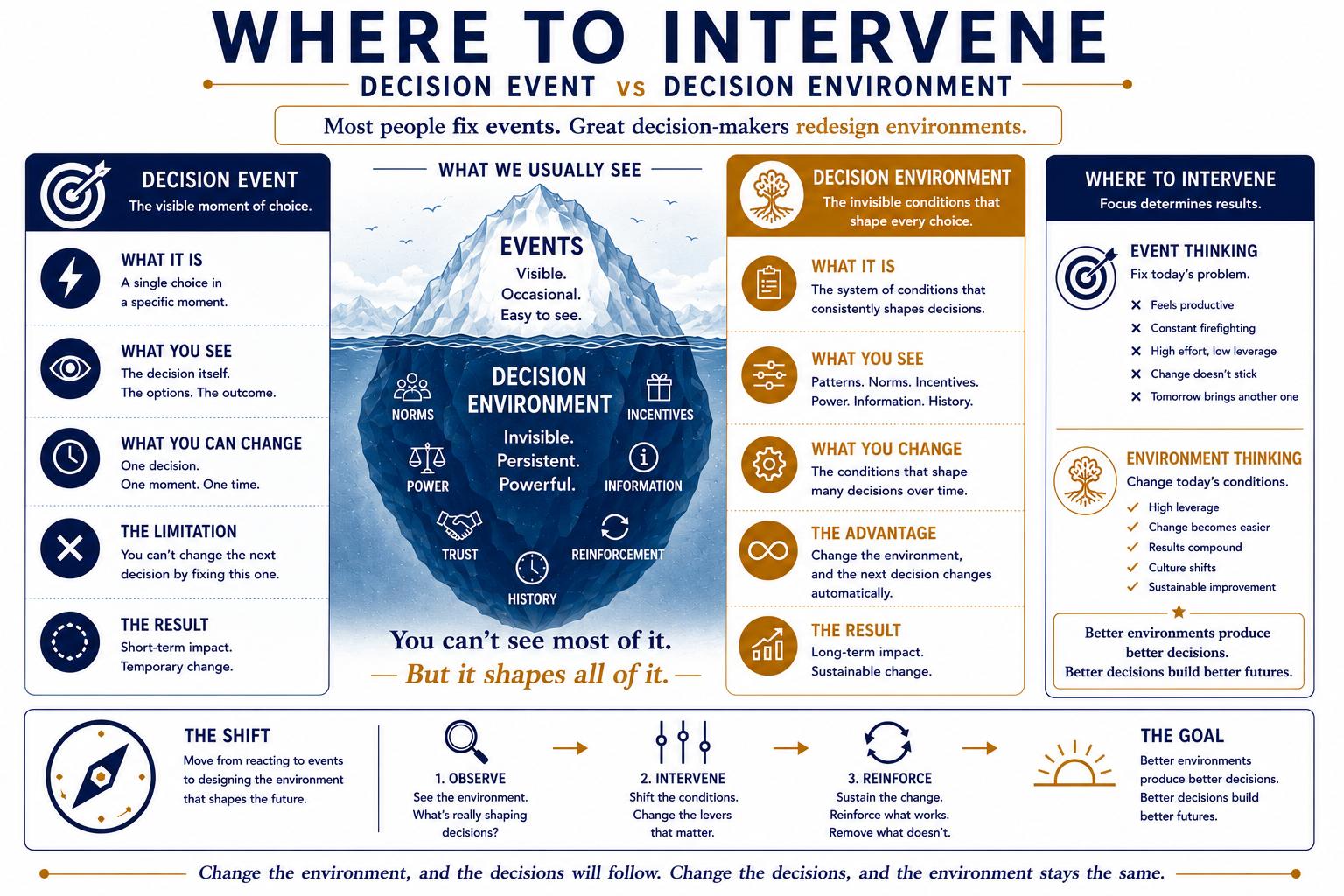
Decision Event vs. Decision Environment
A distinction for separating what happened from the persistent conditions that made it likely.
A decision event is the visible moment of choice or outcome. A decision environment is the surrounding system of norms, incentives, power, information, trust, history, constraints, and time that shapes what people notice and choose.
When this framework helps.
- A bad hire, missed target, conflict, complaint, or failed initiative is being treated as an isolated event.
- Fixes create short-term movement but the pattern returns.
- The organization keeps changing people without changing conditions.
- You need to decide whether to intervene in today’s outcome or tomorrow’s likelihood.
How to use it.
State the event
Describe what happened in observable language without assigning motive.
Look beneath it
Ask why the event may be a symptom rather than the complete cause.
Describe the environment
Identify the conditions that made this outcome reasonable, safer, rewarded, or difficult to avoid.
Select the strongest conditions
Choose three to five influences that explain more than one part of the event.
Design one environmental change
Change a condition that affects future choices, not only the current consequence.
Define evidence
Specify what behavior or signal would indicate that the environment—not merely the event—has changed.
Worked example
A company makes another poor hire.
The event is the unsuitable hire. The environment might include urgency rewarded over fit, weak role clarity, interviewers lacking decision rights, reference concerns arriving too late, and a norm that challenging the founder’s preferred candidate is unsafe. Replacing the person addresses the event. Changing role definition, information timing, decision rights, and permission to dissent changes the environment.
Common mistakes.
- Pretending urgent event-level action is never necessary.
- Turning systemic analysis into vague discussion of culture.
- Using the environment to excuse harmful choices.
- Redirecting every problem to leadership without examining local conditions.
- Selecting an intervention with no observable test.
Questions people ask.
Should we stop fixing decision events?
No. Immediate consequences often require immediate action. The distinction prevents the event-level response from being mistaken for prevention.
Does the environment determine every decision?
No. It influences what becomes visible, reasonable, safe, and rewarded. People retain agency and responsibility inside those conditions.
What is the practical advantage?
Event thinking can change today. Environmental thinking can alter what becomes likely across many future decisions.