
Free framework · Perspective practice
Observer Shift
A practical method for changing the position from which you observe a decision—before changing the conclusion.
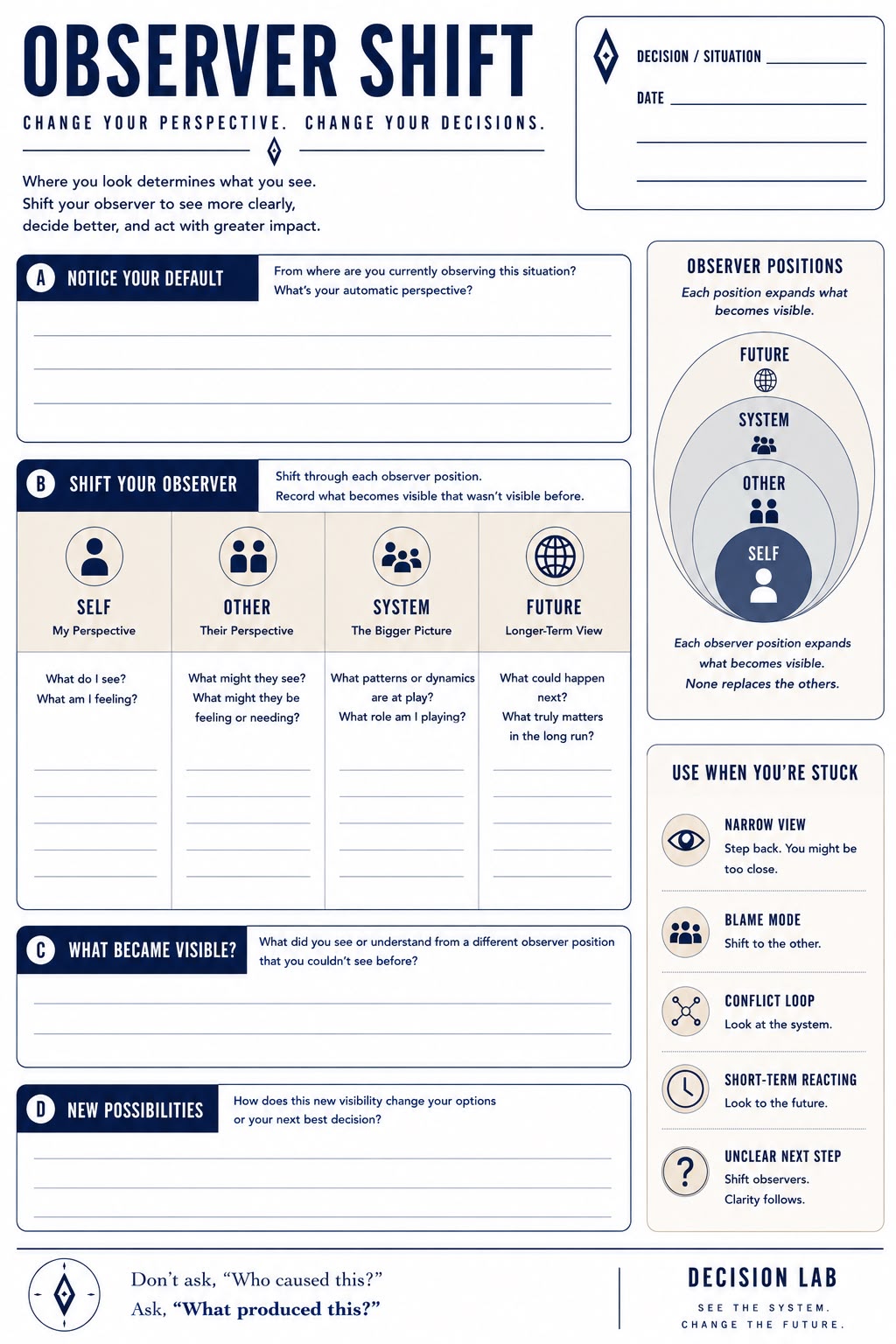
Observer Shift is the deliberate movement between four perspectives—self, other, system, and future—so that no single viewpoint is mistaken for the whole situation.
When this framework helps.
- You feel certain but cannot explain what another person sees.
- A conflict keeps returning to blame.
- The immediate pressure is crowding out longer-term consequences.
- You have more information but no greater clarity.
How to use it.
Notice your default
Write what you currently see, feel, believe, and want before trying to improve the answer.
Shift to other
Ask what another person may see, fear, need, know, or be unable to say.
Shift to system
Look for patterns, roles, incentives, relationships, information flows, and the part you are playing.
Shift to future
Imagine the consequences compounding over time. Ask what will matter after today’s urgency fades.
Record what changed
Capture what became visible from each position without forcing the perspectives to agree.
Reframe the decision
Use the expanded view to identify new options, questions, or evidence requirements.
Worked example
A founder believes a senior employee is resisting change.
From self, the delay looks like low commitment. From other, the employee may see unacknowledged operational risk. From system, past initiatives may have been abandoned after teams absorbed the disruption. From future, another rushed rollout could reduce trust in every later change. The decision may shift from ‘How do I secure compliance?’ to ‘What evidence and ownership would make this change credible?’
Common mistakes.
- Using empathy to invent certainty about another person’s mind.
- Treating the system perspective as an excuse for behavior.
- Assuming the future is a prediction rather than a viewpoint.
- Replacing one observer position with another instead of holding them together.
- Skipping the uncomfortable perspective because it complicates the decision.
Questions people ask.
Is Observer Shift the same as empathy?
Empathy is part of the other position. Observer Shift also includes the decision-maker’s own experience, the larger system, and longer-term consequences.
Which perspective is correct?
None is automatically correct. Each position changes what becomes visible. The practice improves the observation before the conclusion.
When should I use it?
Use it when you feel stuck, certain, blamed, reactive, short-term focused, or unable to identify the next question.